Hidden Jewish Heritage Sites: Beautiful Synagogues Across Europe
- Jul 14
- 4 min read
We’ve all heard of some of the most visited old synagogues in Europe. Whether it be Die Neue Synagogue (The new synagogue) in Berlin, Sinagoga Major de Barcelona (The ancient synagogue of Barcelona) or Nożyk Synagogue in Warsaw, these places receive many visitors each year. But what about the rest of the continent? Jewish communities once existed throughout Europe, not only in the famous centers of Jewish life. And if you’re looking to expand your travel out and explore some lesser-known historic synagogues, you’ve come to the right place. Let’s take the train through Eastern Europe first…
Did you know that Romaniote Jews have been living in Sofia, Bulgaria since the 2nd century CE? That’s centuries older than the more infamous Ashkenaz and Sefardic communities spread throughout central and southern Europe. While much of the synagogues from that time have been destroyed, there’s one Romaniote synagogue that still stands in the city center. Sofia Synagogue, completed in 1909, is one of the two active synagogues in Bulgaria. Here are two reasons not to skip this remarkable synagogue:
First: you’d get to step into a small part of the ancient forgotten Jews of Europe. You'll gain insight into their traditions, prayers, and customs that have survived for centuries. It’s truly special to explore the history of an often-forgotten Jewish group, especially one as ancient as the Romaniotes.
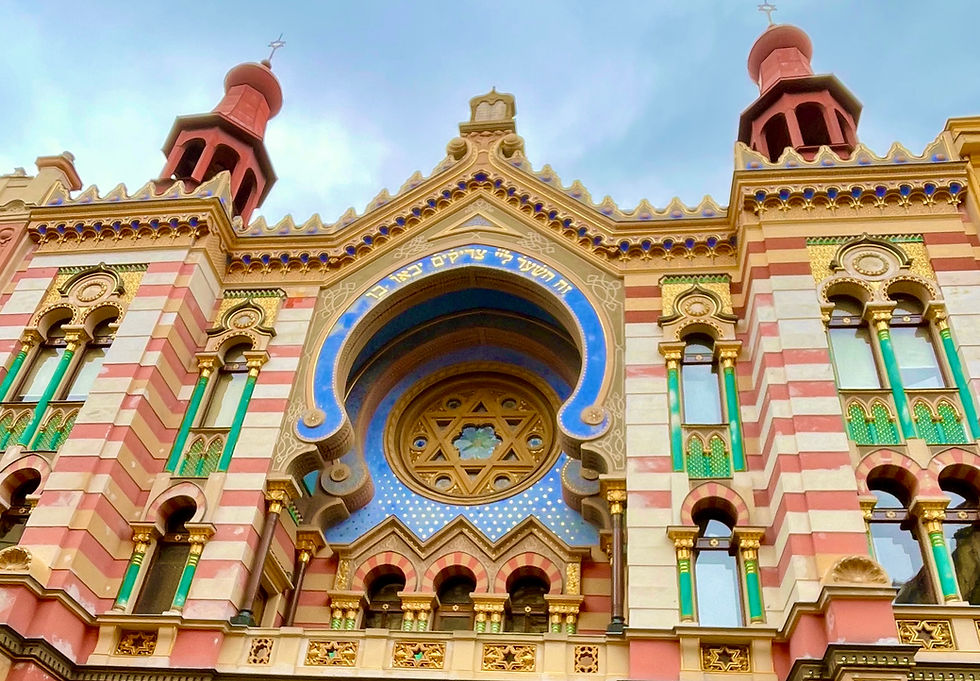
Second: apart from the spirituality and ethnicity the synagogue represents, it’s also a place of great beauty. Built in Moorish Revival style, the walls are painted with intricate pattern, the arches are carved with incredible design, and the astronomical chandelier hanging above the bimah is the largest one in the country. Its domes reflect architectural influences from both the Ottoman and Byzantine Empires, giving the building a distinctive appearance unlike many other European synagogues.
Nowadays you can book a tour to guide you through the synagogue so you don’t miss any details. There’s also a Jewish museum on site talking about the history of the Jews in Bulgaria, as well as how the community was affected by the Holocaust.
Another overlooked Jewish community can be found on the shores of the Baltic Sea. Close to the "Jerusalem of the north”, Vilnius, it often gets overshadowed. I’m talking about Riga, Latvia, a Jewish population old and distinct, and closely linked to its Baltic brothers. While some Jews have been living in parts of what is modern day Latvia since the 14th century, Jews weren't allowed to settle in Riga until the reign of Catherine II in 1766. And in 1905, the Peitav shul, or synagogue, was finally erected. This synagogue sits in the center of the city, a close walk to other tourist sites such as the House of the Blackheads, or the market square.
The building was designed by architect Wilhelm Neumann in the beautiful Art Nouveau style. The aron (arc) is decorated with elegant gold accents, and the balcony is surrounded by intricately painted pillars.
This synagogue is Orthodox Ashkenaz, with its history linking it to Litvish (Lithuanian Jewish) traditions, and Yiddish was widely spoken among its community members, as can be seen on the Yiddish plaque on the wall, commemorating the Holocaust.
What is the oldest standing synagogue in Sweden? It’s not in Stockholm, nor is it in Malmö, a city hosting an impressive Jewish population. It’s the synagogue of Gothenburg, which was completed in 1855. The synagogue was built on former wasteland, as a way of expanding the city. Its exterior was considered a great addition to the scenic location it sits on, facing a moat, and was done in Scandinavian and Celtic designs. The interior resembles more Moorish, Byzantine, and Romanesque style with detailed stained glass windows, grand arches over the balconies, and a pipe organ above the aron or arc.
The synagogue belongs to Gothenburg's Conservative (Masorti) Ashkenazi community. and is still used by the conservative Jews of Gothenburg today as both a place of worship, and gathering.
After recent attacks on the synagogue, open tours are not held like in other cities, but you can email the synagogue staff before your trip and arrange for them to meet you there. Once the security has passed and the timing has been arranged, you’ll be welcomed in with open arms. Inside you’ll be shown the grand prayer hall, the former prayer room used by the orthodox community, and a runthrough of all the historical objects no longer in use. During my own visit, one of the unexpected highlights was being introduced to a Swedish-produced Yiddish comic strip that's still published today - something I never would have discovered without arranging a tour.
If you're looking for even more historic synagogues, here are a few additional stops worth adding to your itinerary:
The choral synagogue in Kaunas, Lithuania which was once a hub of Jewish life and study in Lithuania.
The Moorish-style ashkenaz synagogue in Sarajevo, Bosnia and Herzegovina which was built in 1902 and is the only remaining synagogue in the country today.
And if you’d like to visit a synagogue even older, take a trip to Gibraltar to seek out the first synagogue built on the Iberian peninsula following the Jewish expulsion. The Great Synagogue was completed in the 1720s and is adorned in mediterranean style.
While Europe's famous synagogues deserve their reputation, some of the most memorable experiences come from stepping off the well-worn tourist trail. These smaller communities each preserve their own traditions, architecture, and stories, offering a glimpse into centuries of Jewish life that many travelers never encounter.
If you're planning a Jewish trip through Europe and would like help building an itinerary that includes synagogues, kosher food, Shabbat-friendly accommodations, and other hidden gems, I'd be happy to help.

Comments